
The engineering decisions behind my portfolio
What ForgeLoop, Truss, and PinLeads reveal about how I scope work, design boundaries, handle failure, and make software ready for review.
A portfolio can show what an application looks like. The more useful conversation is how it behaves when a dependency fails, a task is interrupted, or another engineer needs to understand a decision.
My projects give me concrete ways to have that conversation. Across ForgeLoop, Truss, and PinLeads, I work on the interface, backend contracts, persistence, integrations, and deployment. That breadth matters because a feature rarely ends at the edge of a component. A progress indicator needs a reliable account of the work behind it; an approval button needs an enforceable boundary; a retry needs to know which actions already happened.
Here are three decisions that explain how I approach those responsibilities.
ForgeLoop: define what completion means
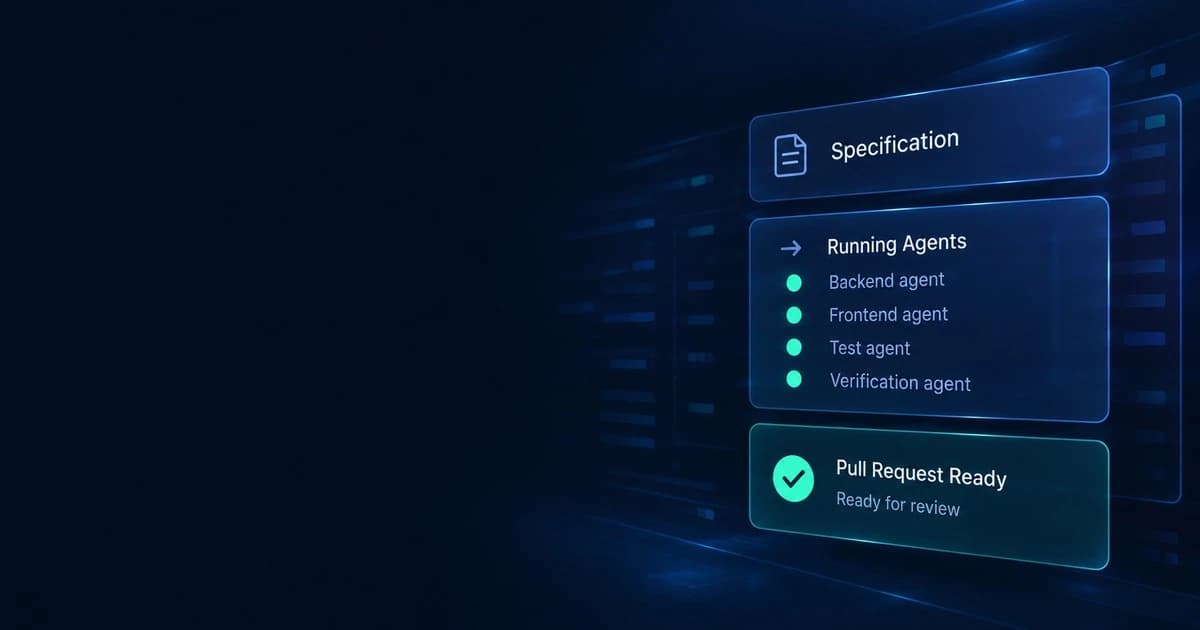
ForgeLoop coordinates coding-agent work through planning, execution, integration, verification, and review. The difficult part is deciding when a change deserves to advance.
I built a separation between the control plane that schedules work and the runner that operates near the repository. Tasks declare dependencies and owned paths. Isolated Git worktrees give execution a defined workspace, and integration uses declared commits. These choices create explicit places to inspect responsibility and recover from interruption.
Verification also needs a specific subject. A green result should be connected to the criterion and commit it checked. Versioned gates and recorded evidence give a reviewer something more useful than the agent's own completion message.
The tradeoff is added coordination: workflow state, leases, artifacts, and failure handling all need implementation and maintenance. That cost is justified when parallel execution and review are part of the requirement. It would be excessive for a simple script.
I also keep the validation boundary visible. The case study distinguishes the demonstrated issue-to-verified-PR path from broader readiness checks that remain open. Being precise about what has been exercised helps the next person decide what to test.
Truss: share the runtime, respect the interface
Truss brings a coding-agent runtime to terminal, editor, desktop, and other developer clients. Each interface has different interaction needs, but model configuration, tool permissions, workspace context, and session state need a consistent foundation.
I separate those shared responsibilities from client presentation. A terminal client can favor keyboard navigation while an editor client uses selected-file context. Both can rely on the same operating model for providers and permissions.
This creates a contract problem worth solving deliberately. If every client owns its own interpretation of permissions or session state, a change becomes harder to implement consistently. Keeping those responsibilities with the host makes their behavior easier to reason about across clients.
The lesson I carry into other work is to share the parts that need the same meaning. Interfaces can remain specific to their users without duplicating the rules underneath them.
PinLeads: design around partial success
PinLeads turns browser-based business discovery into a lead workflow. External pages can fail, browser instances consume resources, and scraping can continue well beyond an initial HTTP request.
I keep browser work in asynchronous jobs, persist progress and accumulated results, and expose status separately to the interface. Browser pooling gives resource use a defined limit. Partial results remain useful when a run stops, and persisted snapshots give recovery a starting point after a restart.
These decisions connect backend design directly to user experience. A person needs to know whether work is running, what was collected, and what can be used next. The interface can communicate that only when the job lifecycle represents it accurately.
Mixed persistence adds an operational tradeoff. Firebase, PostgreSQL, and job snapshots serve different responsibilities in this product. Those responsibilities need clear documentation so debugging and recovery do not depend on guessing where state lives.
What I want a reviewer to be able to inspect
When I hand off work, I want another engineer to find the requirement, the implementation boundary, the checks that ran, and the remaining uncertainty. Useful tests exercise contracts and failure paths. Useful documentation explains why a decision exists and what would justify changing it.
In an interview, these are the details I would want to discuss: why work became a durable job, why credentials stay with a runner, how a client shares state, and what a passing check actually proves. They make it possible to evaluate my judgment alongside the code.
The projects are different, but the responsibility is consistent. I aim to leave software that users can follow, reviewers can assess, and another developer can continue working on.